There's a particular kind of nervous energy in the weeks before you go out on your own. You know you can fit, you know you can look after a customer, and you're tired of building someone else's business when you could be building yours. It's daunting and exhilarating in equal measure, and that's exactly how it should feel. You're about to own your margin, your reputation and your diary.
Here's the encouraging bit: the fitters who make this work aren't smarter or luckier than you. They just get a handful of foundations right early, so the business carries them instead of the other way round. Compliance, cash and one tidy place for your jobs aren't admin to dread. They're the scaffolding that lets you charge what you're worth, sleep at night, and grow with confidence. Get these in place and the leap becomes a lot less of a gamble and a lot more of a plan. Let's walk through them, whether you're leaving an employer, stepping up from subcontracting, or turning a side hustle that's already ringing into the real thing.
The timing is genuinely on your side
This is a great trade to back yourself in. The UK fenestration market is worth around £3.5 to £4 billion and, after a flat couple of years, is forecast to grow roughly 2 to 3% a year through 2029 as energy efficiency and replacement demand hold up (Glazing Today, market prediction 2026). It's not a gold rush, it's something better: steady, dependable demand that rewards people who fit well and run a tight ship.
There's room being made for you, too. The number of PVCu fabricators has fallen from 1,534 in 2014 to 1,132 in 2025 (Insight Data, fenestration market analysis) as weaker operators bow out. Homeowners are choosier than ever about who they trust with a four-figure install, which is brilliant news if you turn up looking organised, certify your work properly, and actually answer the phone. You don't need to be the cheapest. You need to be the one they feel safe choosing, and that's entirely within your control from day one.
Choosing your setup: sole trader, limited company, or subcontracting first
Good news, the legal side is simpler than it looks. Most one-person startups begin as a sole trader: register for Self Assessment with HMRC (free, online), keep basic records, and file a tax return each year. You can start trading straight away, because registration is retrospective within HMRC's deadlines. Going limited makes sense a bit later, once profits are consistent enough that the tax efficiency and liability protection outweigh the extra accountancy, usually when you take on staff or your accountant tells you the maths has tipped.
Subcontracting for an established firm while you build your own base is a smart, low-risk on-ramp. You sharpen your pricing, see how a busy operation really runs, and earn without carrying stock or marketing costs. Just keep your eyes on the prize: set yourself a date to start taking direct work, even if it's one evening-and-weekend job a month to begin with. That's how you start building a customer list, reviews in your own name, and margin on materials, the assets that make it your business rather than someone else's overflow.
Compliance done right becomes a selling point
Don't think of compliance as red tape. Done properly, it's one of the easiest ways to look more trustworthy than half your competition. Replacement windows and external doors in existing dwellings in England and Wales are controlled work under Building Regulations, and you have two clean ways to comply: join a government-authorised Competent Person Scheme and self-certify, or notify local authority building control on every job.
FENSA (or CERTASS) is the route that makes life easy for domestic work. Joining FENSA is a one-off fee of £279.88 ex VAT, then modest annual charges linked to volume: yearly membership, per-job notification (£2.05 ex VAT per installation), and assessment costs. Their own example puts a firm doing 40 jobs a year at under £506 ex VAT in total annual fees (FENSA, installer fees). You'll demonstrate Minimum Technical Competence (MTC), usually via NVQ Level 2 fenestration or, if you've been fitting for years, FENSA's experience-based assessment route, which is a nice recognition of skills you already have.
It's worth seeing the value clearly. Without scheme membership, your customer picks up building control fees instead. Councils set their own charges, and as a guide Oldham's 2025 schedule is £161 inc VAT per installation for up to 10 replacement windows when the contractor isn't on a Competent Person Scheme (Oldham Council, building control charges). Being registered means you hand the customer a certificate and a clean sale, which wins jobs at the kitchen table.
Then get yourself properly covered, and you can work with total peace of mind. Sort insurance before the first ladder goes up: public liability (most domestic work wants £2m minimum, commercial often £5m+), employers' liability the moment you have staff, and tools cover that includes glass and transit. And remember CIS kicks in once you pay subcontractors for construction work, so register correctly and it's a non-event. A quick read of understanding CIS Understanding CIS: A Guide for InstallersRegister correctly, verify subcontractors, apply the right CIS rate, and keep clean monthly records so you avoid 30% deductions and HMRC penalties. before your first labour-only sub will save you any surprises.
What it really takes to fund the start
Here's a relief: you need far less than the eye-watering figures on American "start a window business" blogs. A lean UK start looks more like this.
- Van (owned or leased): often your biggest line, but don't blow the budget on a full wrap before the diary's full. A reliable van and a set of magnetic signs gets you earning, and you can treat yourself to the livery once the work's rolling in.
- Tools and kit: spirit levels, fixings, sealants, PPE, glass handling. Buy quality on the things that touch every job, and rent or borrow specialist kit until volume earns it.
- FENSA/CERTASS and insurance: budget the first year in full so it's handled and off your mind.
- Working capital: this is the one to respect, because you'll often order frames weeks before the customer pays the balance. Aim to start with one to two months of operating costs in the bank and you'll trade with a clear head instead of a knot in your stomach. If your savings aren't quite there yet but your plan is solid, the government's Start Up Loan scheme is a genuinely useful leg-up: £500 to £25,000 for UK businesses trading less than five years, an unsecured personal loan fixed at 7.5% interest over one to five years, plus free business-plan support and up to 12 months of mentoring. It can bridge the gap between handing in your notice and your first steady month of installs.
One mindset that pays off forever: price for margin from job one. Industry net margins are thin (often around 2% for average operators), so undercutting to "get started" just trains customers to expect cheap and leaves you nothing to reinvest. Quote against your real costs, labour, materials, waste, van time and a callback allowance, and you'll build a business that pays you properly. Calculating job costs Calculating Job Costs: Tools and Tips for Accurate QuotesJobs that look fine on the quote still leak margin when you skip consumables, overhead and contingency, and tight costing with real labour and supplier numbers is how you stop donating profit. and why firms lose money on jobs
 Why Window Fitting Companies Lose Money On JobsJobs rarely lose money in dramatic ways, they bleed it in measurable places you can't see unless you compare what you quoted with what the job actually cost, which is the one habit most fitters skip. are the perfect primers before you set your rate card.
Pick the right partners, and stand for something
Your manufacturer relationship shapes your range, your lead times and your backup when something's not right, so choose it like the partnership it is. Don't just default to the biggest name or the cheapest list. Find a fabricator who picks up when a frame's wrong, delivers to your patch reliably, and is happy to support a startup volume. One strong trade account you trust beats three you barely use.
Then give customers a reason to pick you beyond price. "We fit anything anyone sells" puts you in a race to the bottom with every handyman with a van. A clear offer (replacement PVCu and aluminium, your local postcodes, FENSA-registered, insurance-backed guarantees) lets you charge for competence. And if there's a niche you love, heritage sash, big bi-folds, landlord packages, leaning into it can make you the obvious local choice. For the deeper playbook on building a brand customers seek out and remember, how to stand out from the competition How to make my window fitting business stand out from the competitionLook and sound like every other local firm and you get picked on price, so standing out means owning a clear position, winning the reputation race before the enquiry, and being the easiest firm in your area to deal with. is well worth your time, and winning sales proposals
 Strategies For Winning Sales ProposalsVague quotes that look like everyone else's cost you site visits, back-and-forth and margin, and clear itemised proposals with proof and guarantees win better-fit jobs. shows how the quote itself can sell that positioning for you.
Landing your first customers
You don't need a big ad budget to fill those early weeks. Your first jobs almost always come from people and places close to home.
- Former employer and trade contacts, handled the right way: no poaching clauses, no borrowed customer lists, just goodwill and word of mouth.
- Local visibility: a complete Google Business Profile, a simple lead-focused website, and a photo of every finished job.
- One good partner, an estate agent, builder or conservatory firm who'll trial you on a small job. Turn up on time, certify properly and invoice without chasing, and you become their go-to.
- Reviews from day one: ask on completion while the house still looks transformed and the customer's delighted.
Get into the habit of noting where every enquiry came from, right from the first call. It costs nothing and quickly tells you exactly what to do more of. Track referrals Where does your work actually come from? How to track referrals properlyYou can't nurture your best referrers or spot them going quiet if you don't know which relationships are actually sending quoted and invoiced work. and how to get more customers
 How to get more customers for a window fitting businessMost window jobs are decided before anyone calls you, so winning customers means showing up in local search, earning reviews, and responding faster than the other two firms on the shortlist. will help you turn that early word of mouth into something that compounds.
Set up your system on job one
If there's one gift to give your future self, it's this: start organised. It's tempting to say "I'll get a proper system when I'm busy", but busy is exactly when you won't have time to move off WhatsApp, the camera roll and a notebook. UK tradespeople lose an average of 7 to 8 hours a week to admin, much of it evenings and weekends (UK Admin Drain Report 2026). Start tidy and you keep those evenings for yourself.
From your very first enquiry, keep one record per job: customer, survey notes, photos, quote, schedule, certificate, invoice. Use digital survey forms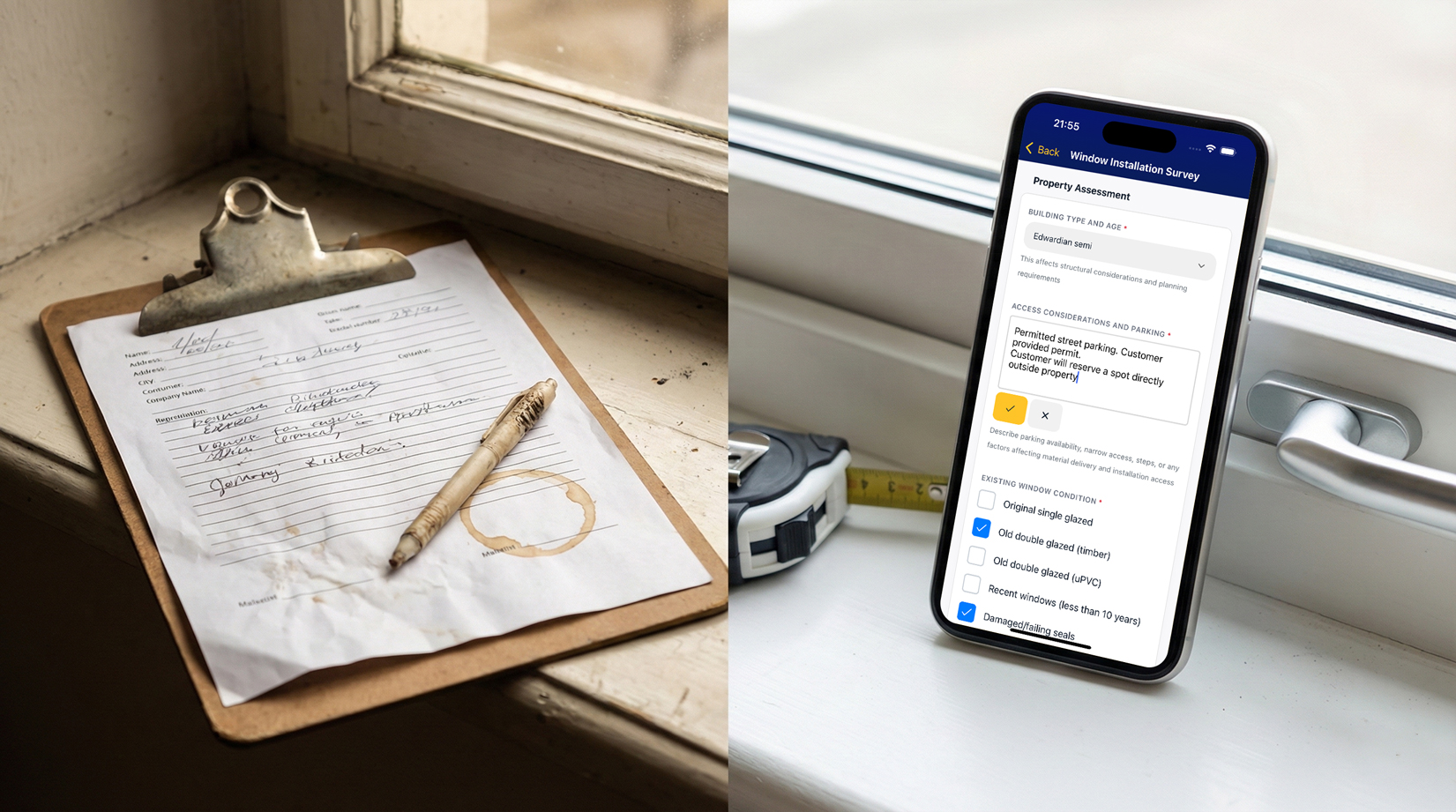 Digital survey forms for window fitters: why paper is costing youDigital survey forms on site replace lost paperwork, illegible notes and disconnected photos with data the office can quote from immediately. so measurements aren't on the back of a fag packet, attach photos by stage as you go, and follow up every quote
 Why your window fitting quotes keep going cold (and the follow-up system that fixes it)Most quotes go cold from inertia, not price, and a timed follow-up sequence on every outstanding quote is the cheapest way to lift win rate without booking another survey. the same way every time. That simple discipline is what quietly turns a one-person operation into a real business, even one someone might want to buy one day. How to organise a window fitting business
 How to organise a window fitting businessAn organised fitting business knows where every job stands, keeps customers and schedules in one place, and attaches photos to jobs instead of losing them in phones. paints the full picture.
Growing your team when the time comes
There's never been a better moment to be the firm that grows its own talent. The CITB forecasts UK construction needs around 41,200 extra workers a year to 2030, with experienced hands leaving faster than new ones arrive (Construction News, CITB workforce outlook). Skilled fitters are in demand, so the owners who win are the ones who train and keep their own.
No rush to hire, though. While you're solo, lean on labour-only subs when you need a hand (with CIS, insurance and your own quality checks in place), and bring someone on permanently when the work is genuinely steady. When you do, apprenticeships Apprenticeships for Small Window Fitting CompaniesWhen good fitters are nearly impossible to hire, growing your own through a structured apprenticeship is often cheaper and more reliable than poaching from a competitor. are a brilliant long-term route to a loyal fitter, especially once you've got the time to mentor properly. Get the diary and the job record humming first, and your first hire will feel like an upgrade rather than a panic.
Three habits that set the best new firms apart
They know their numbers. Once you understand your cost per day and your remake rate, every quote is confident rather than a guess, and the quiet months hold no fear.
They grow on solid ground. Add the second van once the first diary runs like clockwork, not before. Stop double-booking How to stop double-booking your fitting team (without a wall calendar)Double-bookings are almost never carelessness; they're what happens when your diary lives in three places and nobody sees the full picture at the moment they say yes. is worth a read as you scale.
They get paid well and on time. Take deposits, stage payments on bigger jobs, and invoice on completion while you're still on the drive. Healthy cash flow is what makes the whole thing feel easy.
You've got this
Starting a window fitting business is one of the most rewarding moves you can make in this trade. The demand is there, room is opening up, and customers are actively looking for someone who does it properly. All you have to do is back yourself and set the foundations with intent.
Get registered, insured and certificated before you need them. Price for real margin. Win your first customers through trust and visibility. And run every job through one system from the start, so growth feels like momentum rather than mayhem. Do that, and you're not gambling, you're building something that's genuinely yours.
FitterPal is built to walk this journey with you: enquiries, surveys, photos, quotes, schedule and invoices on one job record, so you start tidy and stay that way. And when you're ready to grow beyond solo, the same foundation is right there to scale on How glazing business owners can grow their businessGrow your glazing business by fixing the basics first, winning more of the work you quote, getting found locally, and building systems that scale without adding chaos..
Book a demo and we'll help you set your new business up properly from day one.