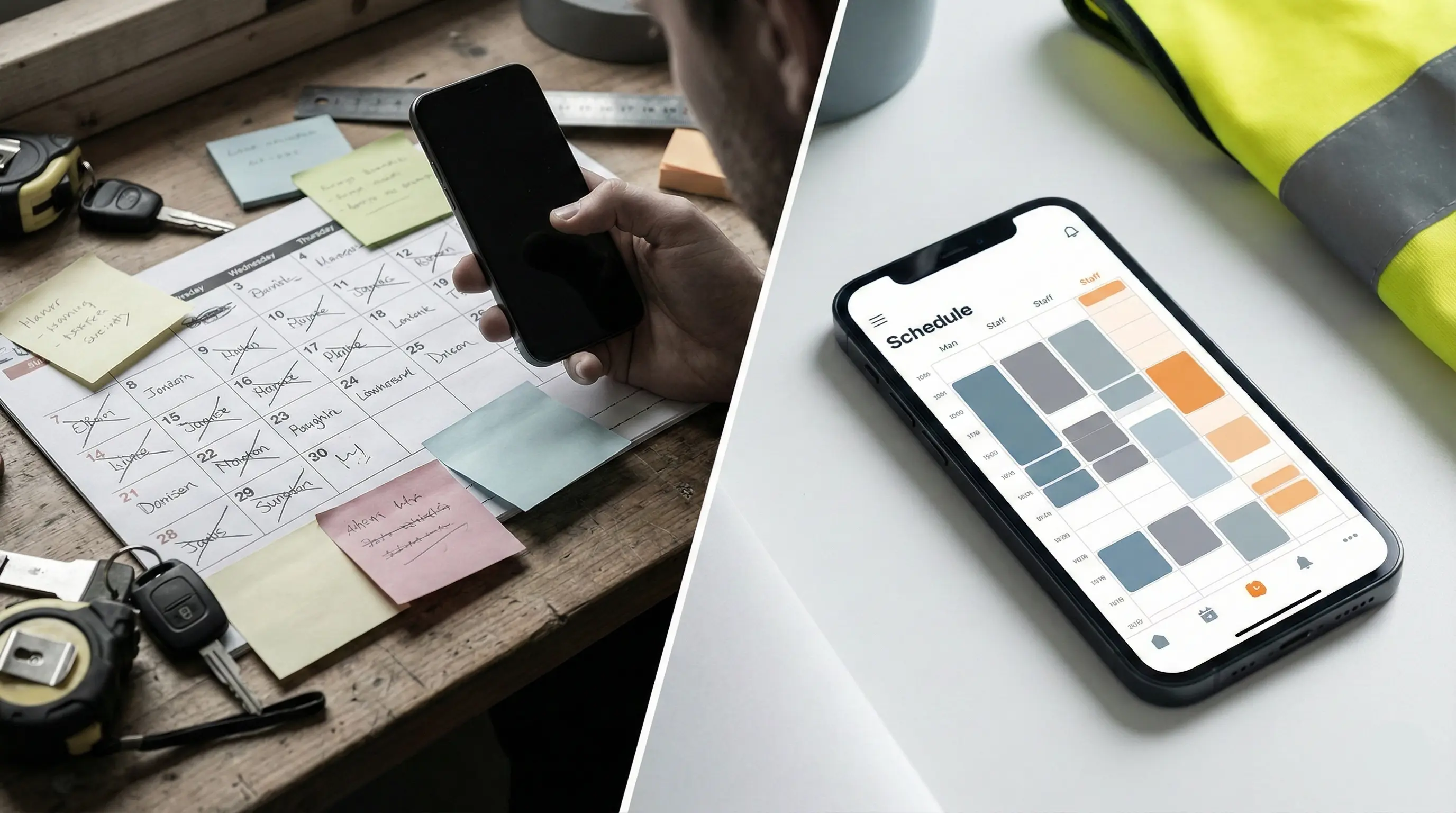
It's 7:15am. Two vans are rolling to two different addresses. Both fitters think they're on the Henderson job today. One of them is wrong, and you're about to find out which when your phone starts ringing.
Double-bookings aren't just embarrassing. They're a full day of wages and fuel spent not fitting, a customer questioning whether they chose wisely, and an afternoon unpicking the diary instead of quoting. Experienced fitters know this pattern. The mistake is usually blaming whoever confirmed the date instead of fixing how dates get confirmed.
Fragmentation, not incompetence
Double-bookings happen when the schedule lives in more than one place at once: wall calendar in the office, Google Calendar on your phone, a WhatsApp message The hidden cost of running your fitting business from WhatsAppWhatsApp feels free until your job photos, customer history and fitter knowledge live on personal phones instead of in the business, and then every dispute, handover and evening ping has a hidden cost. that said "Dave Thursday", and whatever the fitter wrote in his notebook. Each source is partly right. None is complete. Conflict becomes inevitable the moment someone books against the view they can see, not the view that exists.
The usual triggers:
Booking from the van. Customer calls to confirm install. You check your phone calendar, see Thursday clear, say yes. The office already pencilled a survey for Dave that morning. Different calendar. Same fitter. Same Thursday.
Multi-day jobs with single-day blocks. You book a two-day install but only block day one because you'll "remember" it runs over. Three weeks later you don't. Someone else takes day two.
Pencil marks that became real. "Provisional" on the wall calendar turns into a customer expectation, but the official diary never got updated. Now you're choosing who to disappoint.
Two people, one slot, no owner. Surveys get booked by the office. Installs get booked by you. Neither checks the other's column before committing.
The common thread isn't that your team doesn't care. It's that nobody sees availability at the moment they're making the commitment.
The wall calendar stops working when the team leaves the room
Wall calendars feel reliable. Visible, tangible, satisfying to fill in with a marker. They work when the business fits in one head and everyone passes the same whiteboard twice a day.
They fail when fitters live on site. Tomorrow's plan isn't on the wall, it's in a text chain someone half read. Mid-week, a job slips because glass is late. The wall doesn't update itself. Someone rewrites a box, then tries to notify three fitters who aren't in the office. By Wednesday the board is a record of what you intended on Monday, not what's actually happening.
Research on construction teams found professionals spend around 35% of the working week on non-productive activity, including more than five hours just hunting down job information (FMI, Construction Disconnected). A lot of that hunting is schedule-related: "Am I still at the Hendersons?", "Did that move to Friday?", "Who's got the address?" Those questions aren't free. They're billable time leaking into coordination.
What a diary actually needs to do
Forget feature lists for a moment. A scheduling setup that stops double-bookings needs three things, reliably:
Show availability while you're still on the phone. When a customer asks for Thursday, you need to see which fitters are genuinely free that day, including surveys, continuations and travel gaps, before you say yes. Not after you hang up and ring the office.
Be the single source of truth. One schedule everyone trusts. If it's not in the system, it's not booked. Full stop. Not wall plus Google plus memory. See scheduling software for installers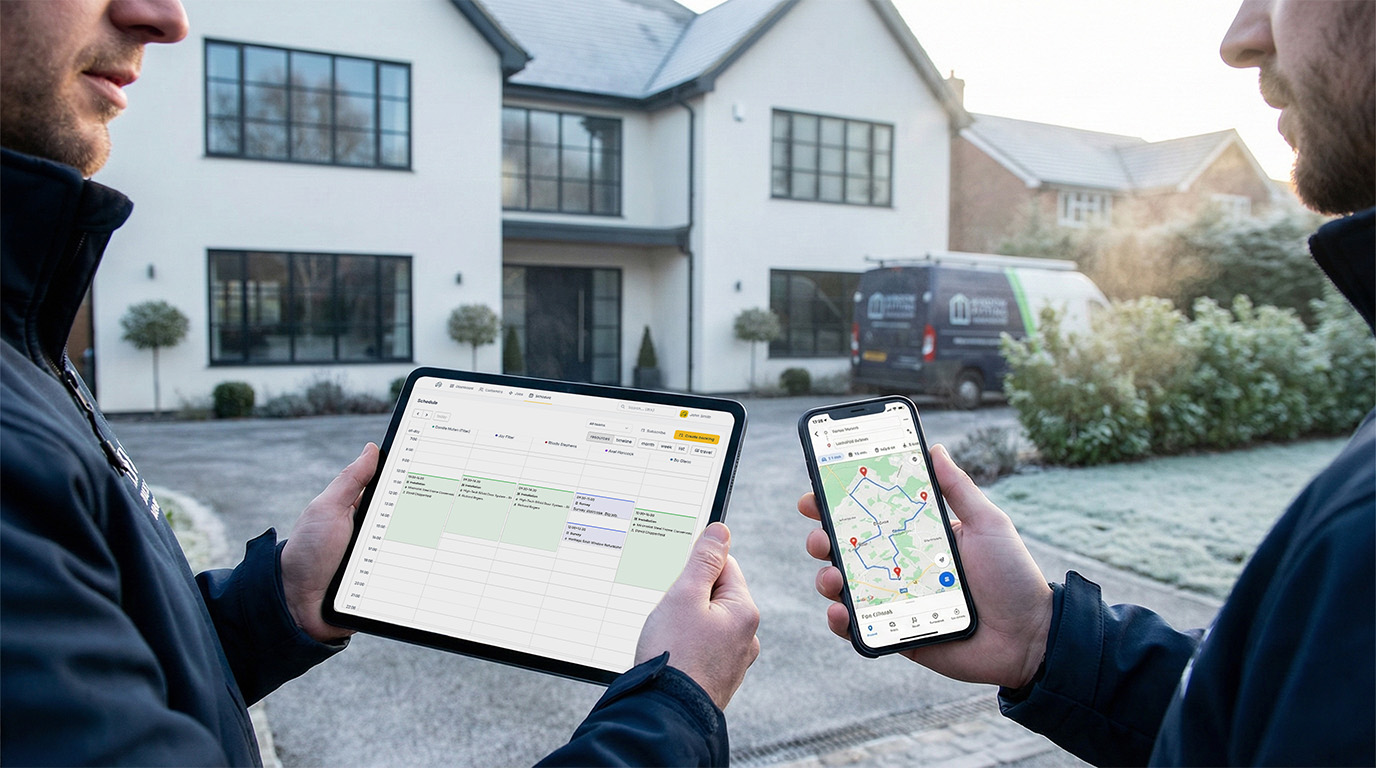 Scheduling software for installersInstallers need scheduling that shows who's where, notifies customers and staff automatically, and gives fitters their day on their phone without group-chat chaos. for what that looks like in practice.
Travel with the team. Fitters check tomorrow from the van before they set off. Changes made once appear everywhere. No cascade of texts hoping everyone saw the update.
That's it. Not AI route optimisation. Who's doing what, when, and can everyone see the same answer.
Rules that work on a busy week
Software helps. Discipline closes the gap. These are the habits firms use once the diary is central:
Block the full job, not the optimistic version. Two-day install means two days blocked, or one multi-day booking that spans both. "I'll remember" is how day two gets sold twice.
Separate survey, install and remedial. They consume different capacity. A day that looks empty because nobody marked the remedial at 2pm isn't empty.
One person owns the commit. Someone says yes to a date, their name goes on it. When two people can book the same fitter without checking, you will eventually collide.
Build overrun buffer. Jobs that always finish at 4pm get booked until 3pm. The diary that assumes perfection is the diary that double-books by Easter.
Reschedule once, visibly. Move the booking in the system. The fitter's view updates. The customer gets told. Chasing three people by text after a wall-calendar rub-out is how one change becomes three conflicting versions.
The cost isn't the wasted journey
Site productivity studies consistently find only around 30 to 40% of a field day is genuine tool time. The rest goes to travel, waiting, hunting materials and doubling back (Kwant.ai, construction site productivity analysis). A double-booking adds another slice: a crew driving to the wrong job, standing in a driveway calling the office, then reshuffling the rest of the week.
Rough maths for a two-person install crew: half a day lost between them (£200–300 in labour), fuel and time on the road (£30–50), the customer you let down now needing a new slot (often pushing into next week), and materials timed for a day that didn't happen. One clash a month can easily cost £500 in direct waste and several times that in diary knock-on. At 2% net margin How The Best Window Fitting Companies Stay ProfitableIn a trade running on roughly 2% net margin, profit is won in percentage points, and the best firms protect them through disciplined pricing, near-zero rework and tight scheduling rather than by fitting more windows., that's not an admin annoyance. It's a profit problem dressed as a scheduling slip.
How FitterPal keeps one diary honest
FitterPal shows staff in columns and time in rows: today's installs, tomorrow's surveys, what's running over. When you book, you're looking at the same live view, so a two-day job at the Patels visibly consumes Wednesday and Thursday before you commit Dave.
Each booking ties to the job, not just a surname. Tap through and the fitter sees access notes, survey photos, glass spec and customer contact. They're not decoding "Henderson 9am" from memory. Because it's on their phone and in the mobile app, they check it from the van, the supplier queue, or site when plans shift. Move a booking once and everyone sees it. Reschedules don't depend on someone noticing a text in a group chatThe hidden cost of running your fitting business from WhatsAppWhatsApp feels free until your job photos, customer history and fitter knowledge live on personal phones instead of in the business, and then every dispute, handover and evening ping has a hidden cost..
For the wider operating picture, see how to organise a window fitting business How to organise a window fitting businessAn organised fitting business knows where every job stands, keeps customers and schedules in one place, and attaches photos to jobs instead of losing them in phones. and time management for home improvement businesses
 Time-Management Hacks Every Home Improvement Pro Should KnowReclaim hours in your week by batching your admin, protecting time on the tools, and killing the constant task-switching that quietly drains a fitter's day..
When to move on from the wall
Nothing wrong with how you started. Whiteboards and wall calendars get plenty of firms to two vans and a steady diary. They stop scaling when the team isn't in the same room, when multi-day jobs multiply, and when one clash a month starts costing more than the effort of a proper system.
The goal isn't a complicated dispatch operation. It's one schedule everyone trusts because everyone can see it at the moment that matters: when someone says "yes, we can do Thursday."
Book a demo if you want to walk through FitterPal's schedule and how bookings link to the full job record.