
You don't lose time because you fit windows slowly. You lose it in the gaps: the call mid-install, the quote you stop to write, the supplier you ring back, the paperwork that waits until the evening. The work isn't the problem. The constant switching around it is.
That switching has a measured cost. Research by Rubinstein, Meyer and Evans, cited by the American Psychological Association, found that flicking between tasks can eat up to 40% of your productive time (APA). Every time you break off a job to deal with admin, your brain pays a tax to reorient when you go back. For a busy fitter, that tax is most of the reason the day feels frantic but the diary still slips. Here's how to claw the time back, starting with the highest-leverage changes.
Batch admin instead of bleeding into it all day
The single biggest time win isn't doing admin faster. It's doing it less often. Answering quotes, returning calls and chasing payments in scattered moments throughout the day is what triggers that 40% switching penalty over and over.
Pick one or two fixed admin windows, say first thing and after lunch, and let calls go to voicemail in between. Handle quotes and quote follow-ups Why your window fitting quotes keep going cold (and the follow-up system that fixes it)Most quotes go cold from inertia, not price, and a timed follow-up sequence on every outstanding quote is the cheapest way to lift win rate without booking another survey. in a single block while you're already in that headspace, rather than restarting cold each time. You'll get more done in a focused 45 minutes than in a day of interruptions, and the work on site stops being chopped up.
Protect your time on the tools
Your billable hours are the ones with a tape measure in your hand, not a phone. Yet most fitters let admin colonise the working day and then do the "real" paperwork at night. It's so common that 77% of trade owners report doing admin in the evenings, and nearly half give up part of the weekend to it (UK Admin Drain Report 2026).
Treat fitting time as fixed and build admin around it, not the reverse. If a customer call isn't urgent, it waits for your admin block. The goal isn't to ignore people; it's to stop low-value interruptions stealing the hours that actually pay.
Delegate the work only you think you must do
Plenty of what fills your day doesn't need you specifically. Ordering routine supplies, booking in surveys, sending reminder texts, confirming appointments: these are jobs for a team member, an office hand, or a system, not the most expensive person in the business.
Be honest about which tasks genuinely need your judgement and hand off the rest. Freeing even an hour a day is over five working weeks a year returned to fitting or to a life outside it. If you find yourself saying "it's quicker to do it myself," that's usually a sign the process isn't written down, not that nobody else can do it.
Cut the retyping, not just the paperwork
Manual admin is brutal partly because the same information gets entered again and again: the customer's details into a quote, then a job sheet, then an invoice. UK tradespeople lose 7 to 8 hours a week to admin on average, the equivalent of ten working weeks a year, and a large slice of that is pure duplication.
Keeping customer details, schedules and invoices in one connected system means information is entered once and reused. Trade owners who moved admin onto fitting-focused software report saving around 7.7 hours a week (Gas Engineer Software, 2025 report), close to the entire admin burden. FitterPal does this for window fitters specifically, so the quote becomes the job becomes the invoice without you rewriting a thing.
Stop the time sinks before they start
Some of the worst time losses are self-inflicted and entirely avoidable. A double-booked crew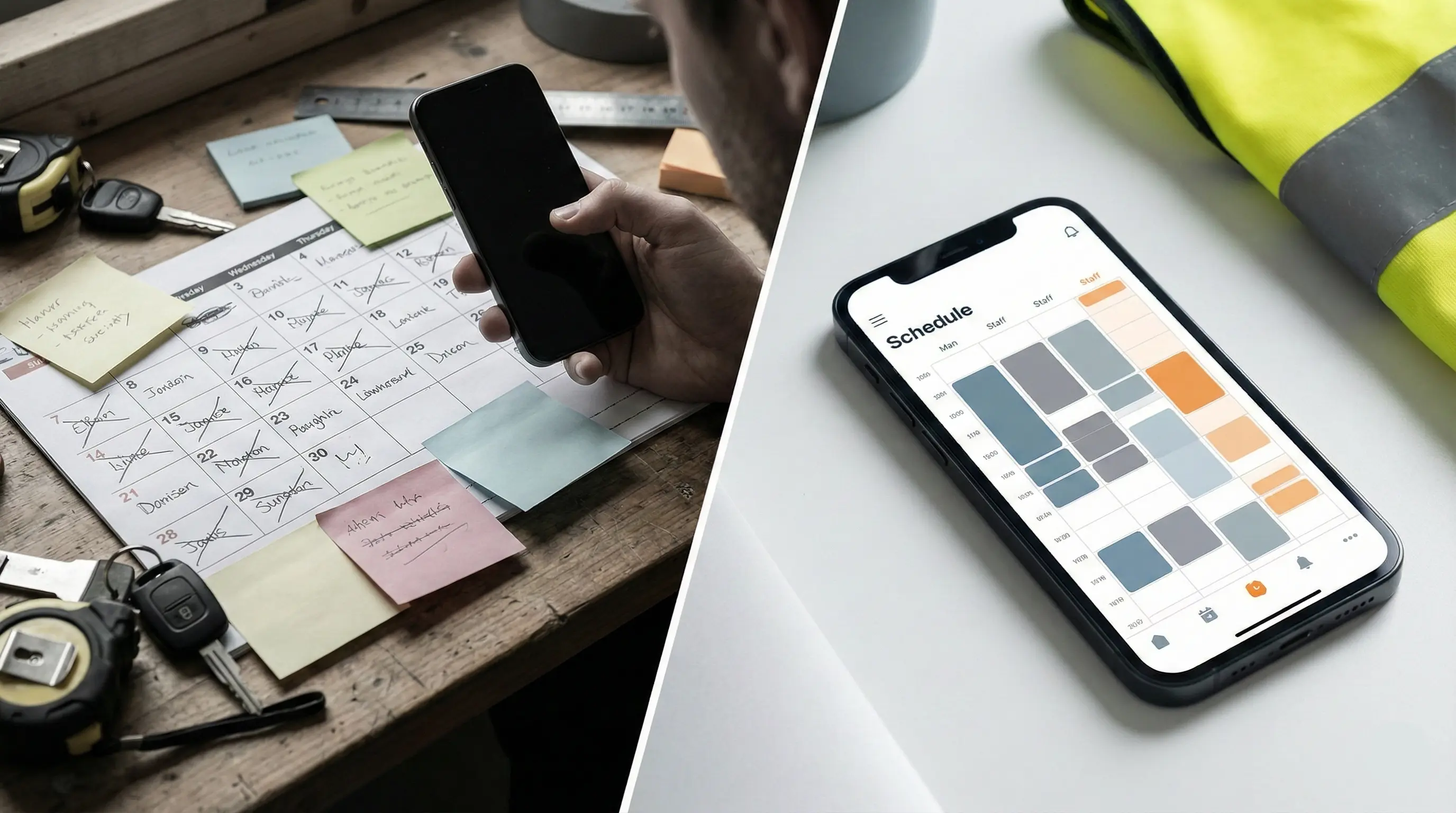 How to stop double-booking your fitting team (without a wall calendar)Double-bookings are almost never carelessness; they're what happens when your diary lives in three places and nobody sees the full picture at the moment they say yes. wastes a whole visit and a difficult phone call. A van sent without a confirmed materials list means a return trip. A vague brief means back-and-forth that should never have happened.
Two habits prevent most of it. First, agree the spec, access and timing clearly with the customer at the survey, so there are no surprises mid-job. Second, keep a small stock of common consumables, sealants, fixings, trims, so a missing fiver's worth of kit doesn't cost you a half-day round trip. Tightening these is part of organising the business How to organise a window fitting businessAn organised fitting business knows where every job stands, keeps customers and schedules in one place, and attaches photos to jobs instead of losing them in phones. so the day runs to plan rather than to the next emergency.
Where to start
Don't try to redesign your whole week. For three days, just notice every time you stop a job to deal with admin. That count is your switching tax, and it's almost certainly higher than you'd guess.
Then fix the biggest source first: usually batching calls and quotes into set windows, or killing the retyping with one connected system. Time management for a fitter isn't about cramming more in. It's about protecting the hours that earn, and refusing to let the rest of the job nibble them away.