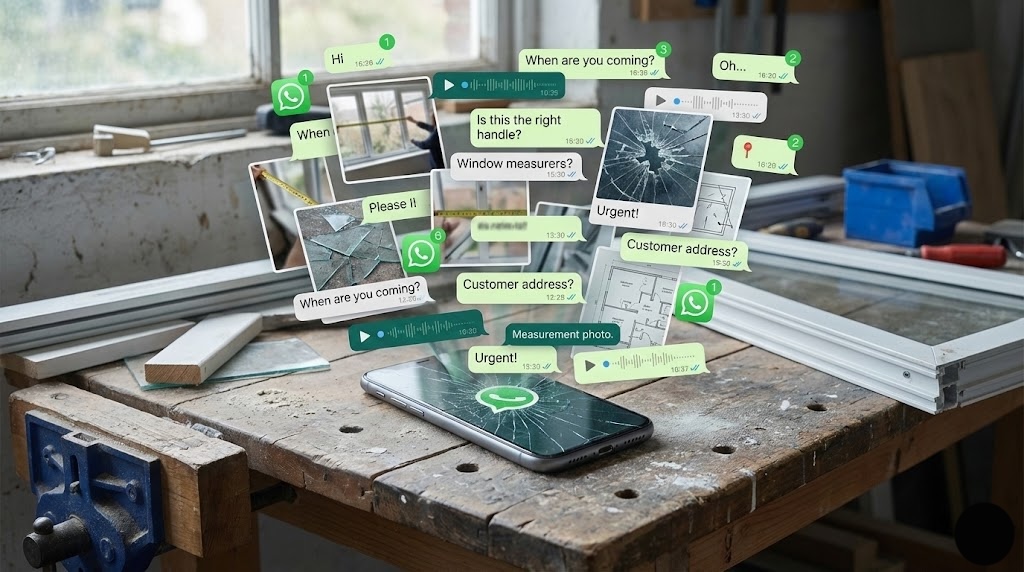
A customer texts you on WhatsApp because it's easier than calling. You reply. They send photos of their existing frames. You ping back availability. Within a month the whole firm is running through green bubbles: fitters, office, suppliers, even the odd builder who only communicates that way.
That's not stupidity. It's the path of least resistance. WhatsApp is on every phone, costs nothing, and feels instant. The problem is what happens when you try to run a proper fitting business on a tool built for chatting with your mates.
The findability test
Try this: find every photo from a job you did eight months ago. The customer's before shots, your fitter's install pictures, the completion images for FENSA. Under two minutes means you're organised. For most firms those files are split across three WhatsApp threads, two camera rolls and a group chat buried under hundreds of unread messages.
When a customer claims you damaged the sill six months later, you need the before photos. When someone asks to see your bi-fold work while you're quoting, you need completion shots on the spot. WhatsApp is brilliant at receiving images and terrible at retrieving them. See before, during, after: organised job photos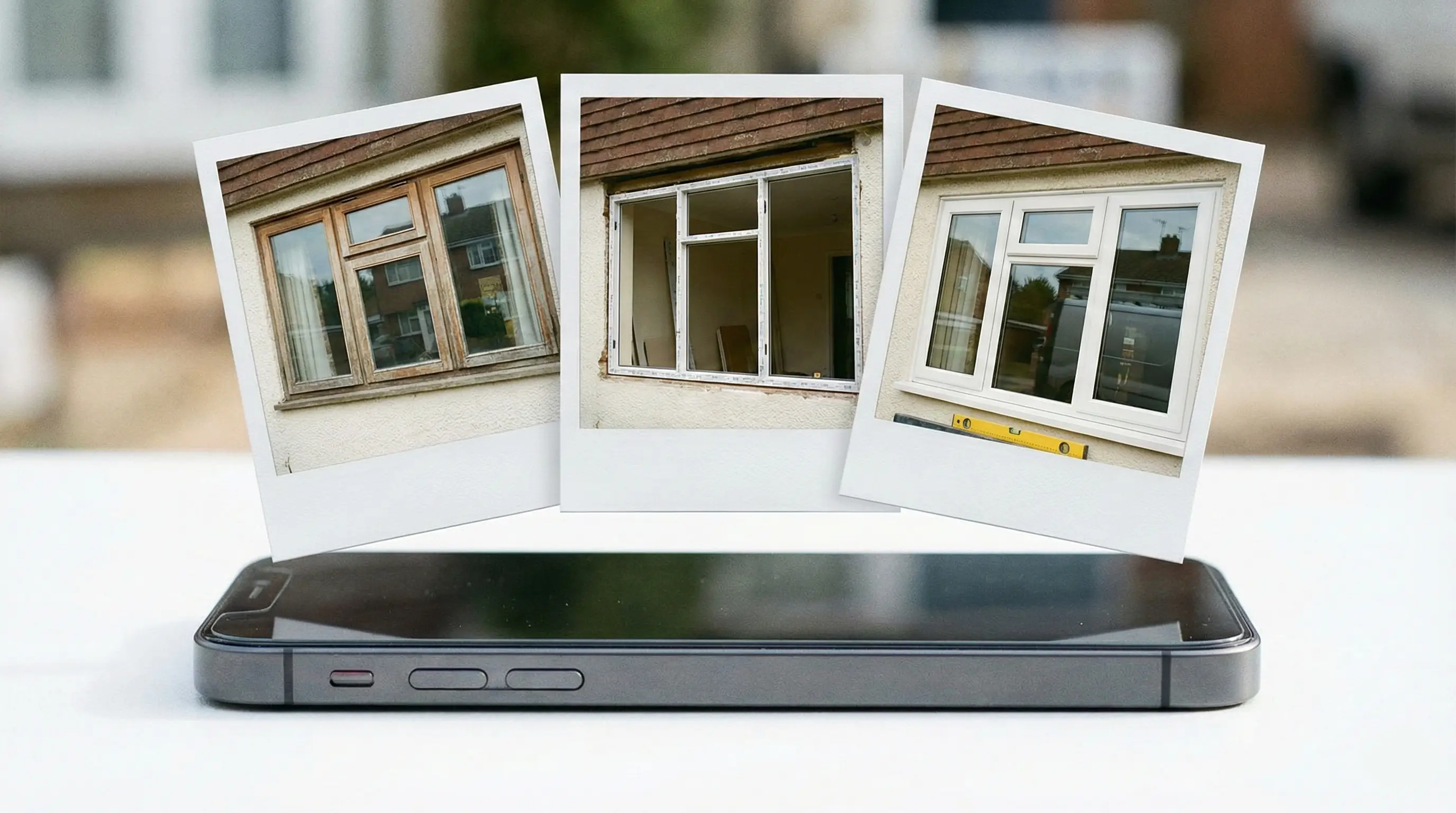 Before, during, after: why organised job photos win you more workOrganised job photos attached to each job by stage are your best defence in a dispute, your fastest sales proof on site, and free marketing you already paid for. for what "findable in seconds" actually looks like.
Voice notes are not a job record
You're on site. The customer mentions a cat flap they discussed with the office. Or was it a letterbox? They definitely spoke to someone. You scroll back through 200 messages, half of them voice notes nobody has time to replay.
So you wing it, call the office mid-install, or ask the customer to repeat themselves. None of that reads as a professional outfit.
WhatsApp threads are linear and endless. There's no way to attach a message to the front windows versus the conservatory quote. Your fitters become archaeologists instead of installers. Poorly communicated job information sits among the top root causes of avoidable error in UK construction (Get It Right Initiative). On a £4,000 install, a wrong hardware spec or missed access note isn't a chat inconvenience. It's a remake eating the margin.
Your business follows you home
Trade owners already bleed admin into evenings: 77% report doing paperwork after the working day ends, and nearly half give up part of the weekend to it (UK Admin Drain Report 2026). WhatsApp makes the boundary worse because it lives on the same phone as your family group chat. Blue ticks imply you're available. A Sunday message about a survey feels rude to ignore and exhausting to answer.
IronmongeryDirect's 2026 trades mental health research found over half of UK tradespeople struggle to balance work and home at least once a fortnight (IronmongeryDirect, Mental Health in the Trades 2026). You didn't become a window fitter to negotiate handles at your kid's football match. When the business line is indistinguishable from personal chat, that's exactly what happens.
When a fitter leaves, the knowledge walks out
Your longest-serving fitter knows Mrs Patterson on Church Lane is fussy about clean-up. He knows the Henderson access is tight and you park two streets away. He knows the developer pays late but always pays.
That knowledge lives in his WhatsApp threads, not in your business. When he leaves, and people do leave, the next visit to Mrs Patterson starts cold. The next quote to the developer doesn't factor payment history. Years of customer context sits on a personal SIM card you can't hand over.
A firm that runs on WhatsApp is a firm where institutional memory is held hostage by whoever happened to get messaged.
The accountability black hole
"I told Dave about the special handle." "No you didn't." "Yes I did, check the chat."
Now someone is scrolling to prove who said what. Maybe it was the group. Maybe a direct message. Maybe a voice note from a Tuesday in March. Messages vanish in the scroll. Voice notes don't index. Quote follow-ups Why your window fitting quotes keep going cold (and the follow-up system that fixes it)Most quotes go cold from inertia, not price, and a timed follow-up sequence on every outstanding quote is the cheapest way to lift win rate without booking another survey. that lived only in someone's head go cold. The illusion of communication replaces a record of what was agreed.
This isn't about blame. It's about knowing the spec, the owner, and the next action without a forensic search through chat history.
What organised actually looks like
The fix isn't banning WhatsApp from your life. Keep it for mates. Stop letting it be your CRM, your photo archive, and your job management system.
Organised means one place where everything about a job lives together: customer details, survey notes, before/during/after photos, schedule, site updates, quote status. Anyone who needs it can see it. When someone leaves, the record stays. That's tracking jobs properly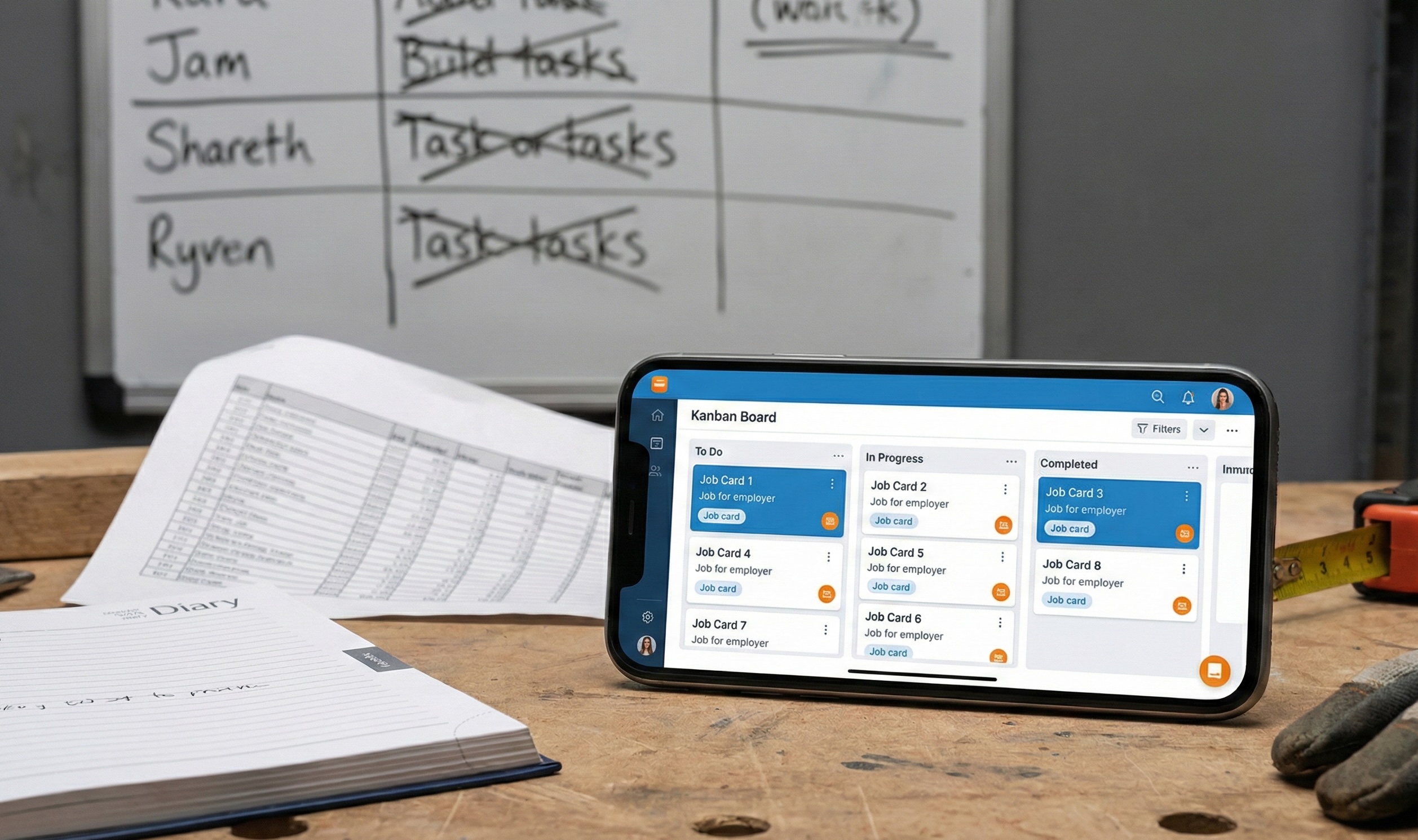 How to track window fitting jobs properlyTracking jobs across WhatsApp, memory and stale spreadsheets stops working around ten live jobs, and one shared record per job with status, photos and schedule is the fix., not hoping someone remembers the thread.
FitterPal treats each job as the container. Photos upload from the fitter's phone straight onto the job. Notes sit where the whole team can read them. Enquiry through completion lives on one record, on web and in the mobile app, instead of scattered across five private chats.
The switch is easier than the chaos
Most owners worry the lads won't use new software. In practice, resistance is to friction, not change. Once a fitter can open a job and see the spec without scrolling six months of messages, they don't want to go back. Once the office can find a completion photo in ten seconds, the arguments stop.
You don't need a six-month IT project. You need one rule: customer-facing information goes on the job, not in WhatsApp. Messages can still alert people. The job record is the source of truth. For the wider picture on replacing scattered tools, see cutting through the chaos Cutting Through the Chaos: How Software Can Simplify Your Window Fitting BusinessRunning your window fitting business across spreadsheets, texts and notes quietly costs you about a day a week; one trade-specific system turns that chaos into time back on the tools. and choosing a window fitting app
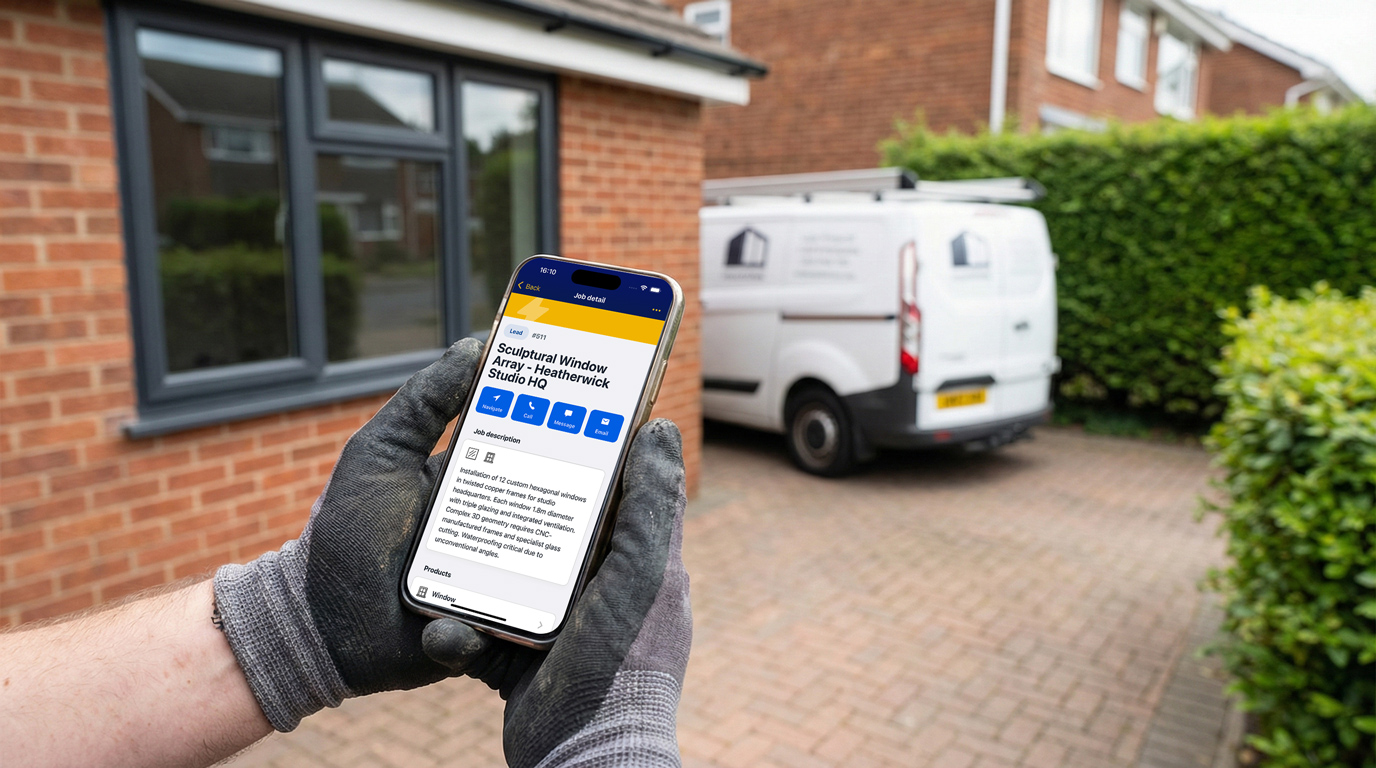 Window fitting app: what to look for and why it mattersA window fitting app should show fitters their schedule and job details on site, work offline, and sync photos and updates back to the office without phone calls..
WhatsApp is free. The leak isn't.
The cost doesn't appear on a bill. It shows up as the hour hunting photos, the remake from a missed detail, the quote that died because nobody chased it, the Sunday you spent answering messages, and the customer history that left with last month's fitter.
Plenty of firms stay on WhatsApp forever. The ones that grow past a van and two lads usually hit the same wall: the tool that got you started can't carry what you've built. Graduate when you're ready. Your mates' group chat can stay exactly where it is.
Book a demo if you want to see how FitterPal keeps jobs, photos and history on the record instead of on someone's phone.