You did the survey. You measured up, worked out the spec, priced the materials, added your margin, and sent a professional quote. Then you went back to running your business - installs to finish, customers to see, suppliers to chase.
A week later, you realise you never heard back. Was it that quote or a different one? When did you send it? Did you have their mobile number? You dig through emails, check your sent folder, try to remember their name. By the time you piece it together, it's been ten days. You call anyway. They went with someone else last Tuesday.
This isn't a memory problem. It's a visibility problem. And it's costing you jobs you should be winning.
Where quotes go to die
Most window fitters track quotes in one of three ways, all of which fail in predictable fashion:
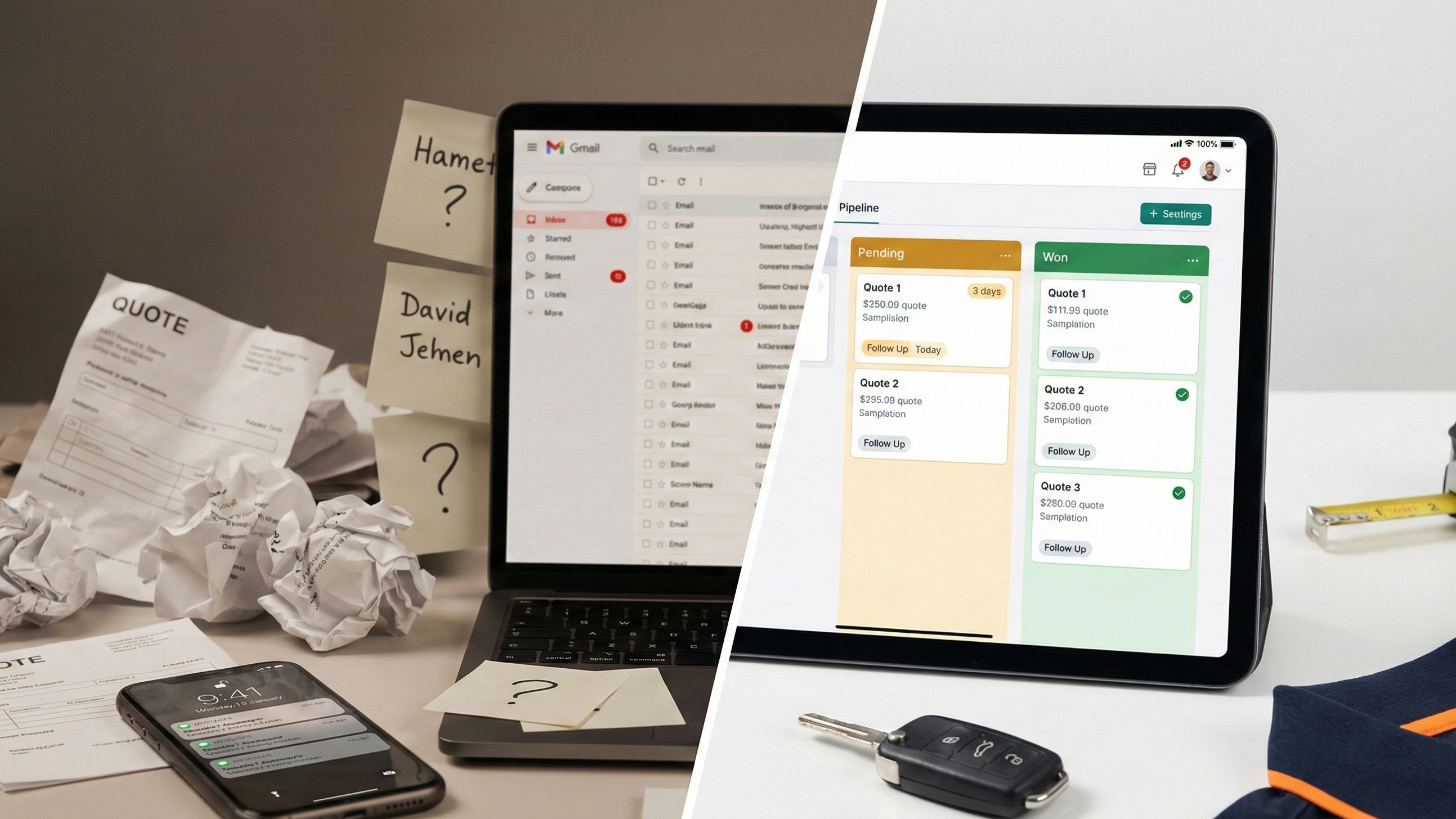
- Email. The quote goes out as an attachment or in the body of an email. Once it's sent, it disappears into the sent folder. There's no status, no reminder, no way to see at a glance which quotes are still waiting. You have to remember to check, and you're too busy to remember.
- Spreadsheet. You keep a list: customer name, job description, quote amount, date sent. It works until you forget to update it. Or until you're updating it from your phone and can't be bothered. By midweek, the spreadsheet shows what was true on Monday, not what's true now.
- Memory. You just... know. Which quotes are out, roughly how long they've been waiting, who needs chasing. This works when you're sending three quotes a week. When you're sending ten or fifteen, your mental model breaks down. Things slip.
None of these methods fail spectacularly. They fail quietly. You don't notice the quotes you didn't chase until months later when you wonder why conversion was low last quarter.
The maths of a missed follow-up
Let's make this concrete. Say you send 15 quotes a month, averaging £2,500 each. You're currently converting about 30%, so that's roughly 4-5 jobs for £10-12k monthly revenue.
Now, how many of those 10-11 lost quotes were actually losable? Some were always going to go elsewhere - wrong price, wrong fit, customer changed their mind. But some were genuinely winnable. They liked you, the price was reasonable, they just needed a nudge.
Industry data suggests that consistent follow-up improves quote conversion by 25-30%. That's not magic - it's just being the fitter who called when the others didn't. If you moved from 30% to 38% conversion, that's one extra job per month. £2,500. £30,000 a year.
Same surveys. Same petrol. Same pricing. Just fewer quotes going cold because nobody chased them.
What the customer is actually thinking
From your side, a quote is sent and then you wait. From the customer's side, something different is happening.
They've probably got three quotes. They're comparing prices, but they're also comparing impressions. Who seemed professional? Who explained things clearly? Who actually seemed to want the work?
The follow-up call isn't pestering. It's evidence. It tells the customer you're organised, you care about their job, and you're the kind of company that stays in touch. The fitters who don't follow up send a different message: maybe they're too busy, maybe they're disorganised, maybe they've got enough work and don't need this one.
Customers rarely articulate this consciously. But when they're choosing between two similar quotes, the fitter who called gets the benefit of the doubt.
What a quote tracking system needs to do
Forget features for a moment. A system that stops you losing track of quotes needs to do four things:
- Show you everything outstanding. One view where you can see every quote that's waiting for a response. Not buried in email threads. Not split across spreadsheets and memory. One place, one list, complete.
- Track how long each has been waiting. A quote sent yesterday is different from a quote sent ten days ago. The system should show you which quotes are ageing, which are going cold, which need attention today.
- Remind you when to act. You shouldn't have to remember to check. The system should surface the quotes that need following up, at the right time, without you having to go looking.
- Give you context for the conversation. When you call, you need to know what was quoted, what was discussed, any notes from the survey. "Hi, just following up on the quote I sent" is weak. "Hi, I wanted to check if you had any questions about the anthracite grey frames we discussed" is better.
That's the baseline. Everything else is nice to have.
How FitterPal handles quote tracking
In FitterPal, a quote isn't a document you send and forget. It's a stage in a job's lifecycle, and the system tracks it.
When you mark a job as "quote sent," the clock starts. The job sits in your quotes pipeline, visible on a board where you can see everything that's outstanding. Each card shows how long it's been waiting. Jobs that are ageing stand out. Nothing hides.
You open the app in the morning and you can see: three quotes need following up today. Not because you remembered, not because you checked a spreadsheet, but because the system surfaced them.
When you tap into a job to make that follow-up call, everything's there: customer details, the quote amount, notes from your survey, photos of the existing windows. You're not fumbling. You know exactly what was discussed and what they're considering.
When they say yes, you drag the job to "confirmed" and it moves to the next stage. When they say no, you mark it lost - and now you have data on your conversion rate, not just a feeling.
The follow-up rhythm that works
There's no magic script for following up. But there is a rhythm that works for most fitting companies:
Day 3-4. First follow-up. "Just checking you received the quote, and whether you had any questions." This is soon enough that you're still fresh in their mind, late enough that they've had time to review.
Day 7-8. Second follow-up if no response. "Wanted to see if you'd had a chance to think it over. Happy to pop back out if anything needs clarifying." This shows persistence without pressure.
Day 14. Final follow-up. "Looks like timing might not be right - just give me a call if things change." This closes the loop gracefully and sometimes prompts a response from people who were genuinely just busy.
The exact timing matters less than consistency. A system that reminds you at day 3, day 7, and day 14 beats perfect timing with sporadic execution.
Knowing your actual conversion rate
Here's something most fitters can't answer accurately: what's your quote-to-job conversion rate?
Not a rough feeling. An actual number. Over the last six months, how many quotes did you send, and how many became jobs?
Without proper tracking, this number is invisible. You might feel like you're converting well, but you don't really know. You can't compare this quarter to last quarter. You can't tell if the new pricing is helping or hurting. You're flying blind.
When every quote is tracked through a system, the data emerges automatically. You sent 47 quotes last quarter, won 16, lost 28, three still pending. That's a 34% conversion rate. Now you have a baseline. Now you can measure whether changes improve it.
You can't improve what you don't measure. And you can't measure what you don't track.
The objection you're already thinking
"I don't have time to log every quote in a system."
Fair. But consider: you're already creating the job somewhere when an enquiry comes in. You're already sending the quote somehow. You're already (sometimes) trying to remember who to chase.
Proper quote tracking doesn't add work. It moves work to a different place - a place where it actually achieves something. Instead of trying to remember who to call, you glance at a list. Instead of searching your email for what was quoted, you tap a job. Instead of wondering about your conversion rate, you see it.
The time investment is a few seconds per quote. The return is the jobs you'd otherwise lose. The maths works heavily in your favour.
The quotes are the easy part
Getting the survey, measuring up, working out the price - that's the hard work. By the time you've done all that, you've earned the job. The quote should be a formality.
But quotes without tracking are bets you place and then walk away from. You've done the work, but you're leaving the outcome to chance. The customer who was going to say yes goes elsewhere because you didn't call. The job that was yours slips to someone more persistent.
FitterPal doesn't make following up automatic. You still have to pick up the phone. But it makes sure you know which phones to pick up, when, and with full context for the conversation.
That's the difference between a quote tracking system and a spreadsheet. Not more work. Less guessing.