It's 7:15am. Two vans are pulling up to two different addresses. Both fitters think they're doing the Henderson job today. One of them is wrong, and you're about to find out which when your phone starts ringing.
Double-bookings aren't just embarrassing. They're expensive. A wasted site visit costs you fuel, time, and credibility. Worse, the customer who got let down is now questioning whether they made the right choice hiring you.
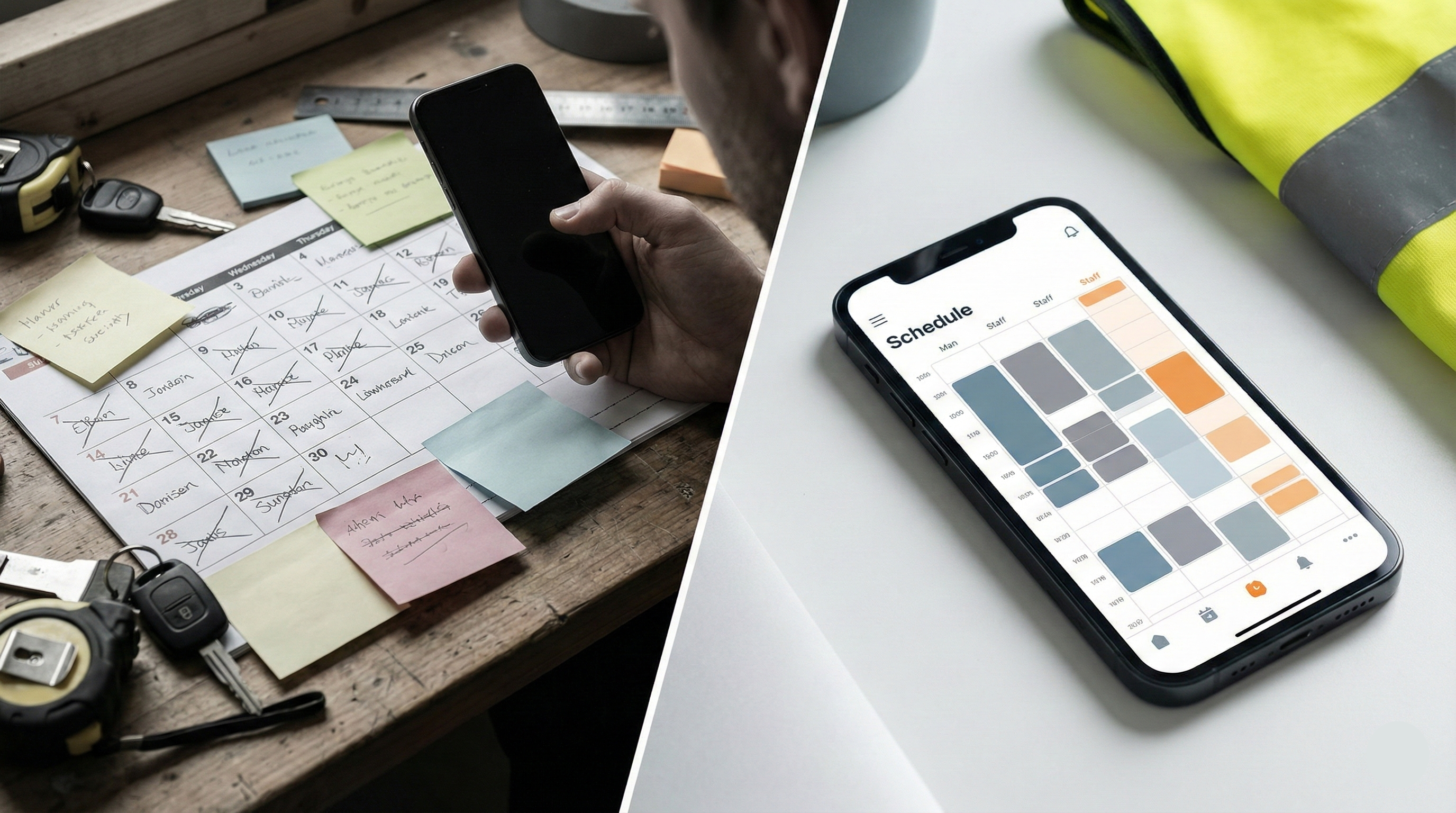
Most fitting companies try to solve this with a wall calendar, a whiteboard, or a shared Google Calendar that nobody quite trusts. These work until they don't. And they usually stop working right around the point where you've got more than two or three people to coordinate.
Why double-bookings actually happen
It's tempting to blame the person who made the mistake. But double-bookings are almost never about incompetence. They're about systems that don't show you what you need to see at the moment you need to see it.
Think about how bookings typically get made in a fitting business. A customer calls to confirm their install date. You're in the van, so you check your phone calendar, see a gap on Thursday, and say yes. What you don't see is that your office already pencilled in a survey for the same fitter that morning. Different calendar. Different system. Same Thursday.
Or this: you book a two-day job but only block out the first day because you'll "remember" it runs over. Three weeks later, you don't remember. Someone else books day two. Now you've got a fitter who needs to be in two places at once.
The common thread isn't carelessness. It's fragmentation. When your schedule lives in multiple places, or in one place that not everyone can see, conflicts become inevitable.
The wall calendar problem
Wall calendars feel reliable. They're visible, they're tangible, and there's something satisfying about writing a name in a box with a marker pen.
But they have a fatal flaw: they only work if everyone's in the same room.
Your fitters aren't in the office. They're on site, in the van, at the supplier. When they need to know what's happening tomorrow, they can't walk over to the wall. So they text the office. Or they try to remember what was said in the Monday morning briefing. Or they check a personal calendar that may or may not be up to date.
The wall calendar becomes the "official" schedule that nobody actually uses in real time. It's a record of intent, not a live source of truth.
And when something changes mid-week - a job pushes back, a customer reschedules, a fitter calls in sick - the wall doesn't update itself. Someone has to physically change it, and then somehow communicate that change to everyone who's not standing in front of it.
What a scheduling system actually needs to do
Forget features for a moment. A scheduling system that prevents double-bookings needs to do three things reliably:
Show availability at the moment of booking. When you're on the phone with a customer, you need to see - instantly - which fitters are free on which days. Not after you hang up and check. Not after you call the office. Right now, while you're talking.
Be the single source of truth. There can only be one schedule. Not a wall calendar plus a Google Calendar plus a spreadsheet. One place that everyone looks at and everyone trusts. If it's not in the system, it's not booked.
Be accessible from anywhere. Your fitters need to see their day from the van. Your office needs to see everyone's day from the desk. Changes made in one place need to appear everywhere, immediately.
That's it. Not AI-powered optimisation. Not drag-and-drop Gantt charts. Just: who's doing what, when, and can everyone see it.
How FitterPal handles scheduling
FitterPal's schedule is built around a simple view: staff in columns, time in rows. You open it up and you see, at a glance, what each person is doing today, tomorrow, or next week.
When you're booking a job, you're looking at the same view. You can see immediately that Dave's got an install on Thursday but Friday's clear. You can see that the two-day job at the Patels runs into Wednesday, so nobody else should be booked that slot. The conflicts are visible before they become problems.
Each booking is tied to a job, not just a name and address. So when your fitter looks at their day, they can tap through to see the full details: what's being installed, any notes from the survey, photos of the site, customer contact details. They're not just seeing "Henderson - 9am" and trying to remember the rest.
And because it's on their phone, they can check it from anywhere. In the van before they set off. At the supplier while they're waiting. On site if plans change. The schedule travels with them.
The Monday morning meeting gets shorter
Here's an unexpected benefit of having scheduling sorted: you stop needing to talk about it so much.
When the schedule is visible and trusted, the Monday briefing stops being a recitation of who's going where. Everyone already knows. The meeting can focus on things that actually need discussion: tricky jobs, customer issues, what's coming up next week.
The daily texts asking "am I still at the Hendersons tomorrow?" stop. The phone calls to check addresses stop. The arguments about who was supposed to be where stop.
It sounds small, but the cumulative time saved on schedule-related communication adds up to hours every week. Hours you can spend actually running the business.
What happens when things change
No schedule survives contact with reality. Jobs overrun. Customers reschedule. Fitters get stuck in traffic or call in sick. The question isn't whether your schedule will change - it's how quickly everyone finds out.
With a wall calendar, changes create a communication cascade. Someone updates the wall, then texts the affected fitters, then hopes everyone saw the message. With a shared digital schedule, the change happens once and everyone sees it.
In FitterPal, if you move a booking, it moves for everyone. If a job gets pushed back, the fitter's view updates and they get an email. There's no "I didn't get the message" because there's no message to miss. The schedule is the message (with bonus features around it).
The real cost of a double-booking
Let's do the maths on what a double-booking actually costs you.
Direct costs: a wasted journey for one fitter. Call it an hour of labour plus fuel. Maybe £40-60 depending on distance.
Knock-on costs: the job that didn't happen now needs rescheduling. That's another conversation with the customer, another slot to find, possibly another few days of delay. If materials were ordered for that day, they might need storing or returning.
Reputation costs: the customer who got let down tells their neighbour. They leave a mediocre Google review. They hesitate before recommending you. This is harder to quantify but it's real.
One double-booking might cost you £50 directly and £500 in ripple effects. If you're having one a month, that's potentially £6,000 a year walking out the door because of a scheduling problem.
The wall calendar served its purpose
There's nothing wrong with how you've been doing it. Wall calendars and whiteboards got a lot of fitting companies off the ground. They work when you're small, when everyone's in the same place, when the business fits in one person's head.
But there's a point where they stop scaling. Where the cost of occasional chaos exceeds the effort of doing it properly. Where you need your schedule to be as mobile as your team.
FitterPal's scheduling isn't complicated. It's just visible, accessible, and singular. One schedule that everyone trusts because everyone can see it.
No more two vans at two addresses. No more "I thought you said Thursday." No more wall calendar that's out of date by Wednesday.
Book a demo today where we can walk you through how our system helps you schedule jobs better.
Book a demo today where we can walk you through how our system helps you schedule jobs better.