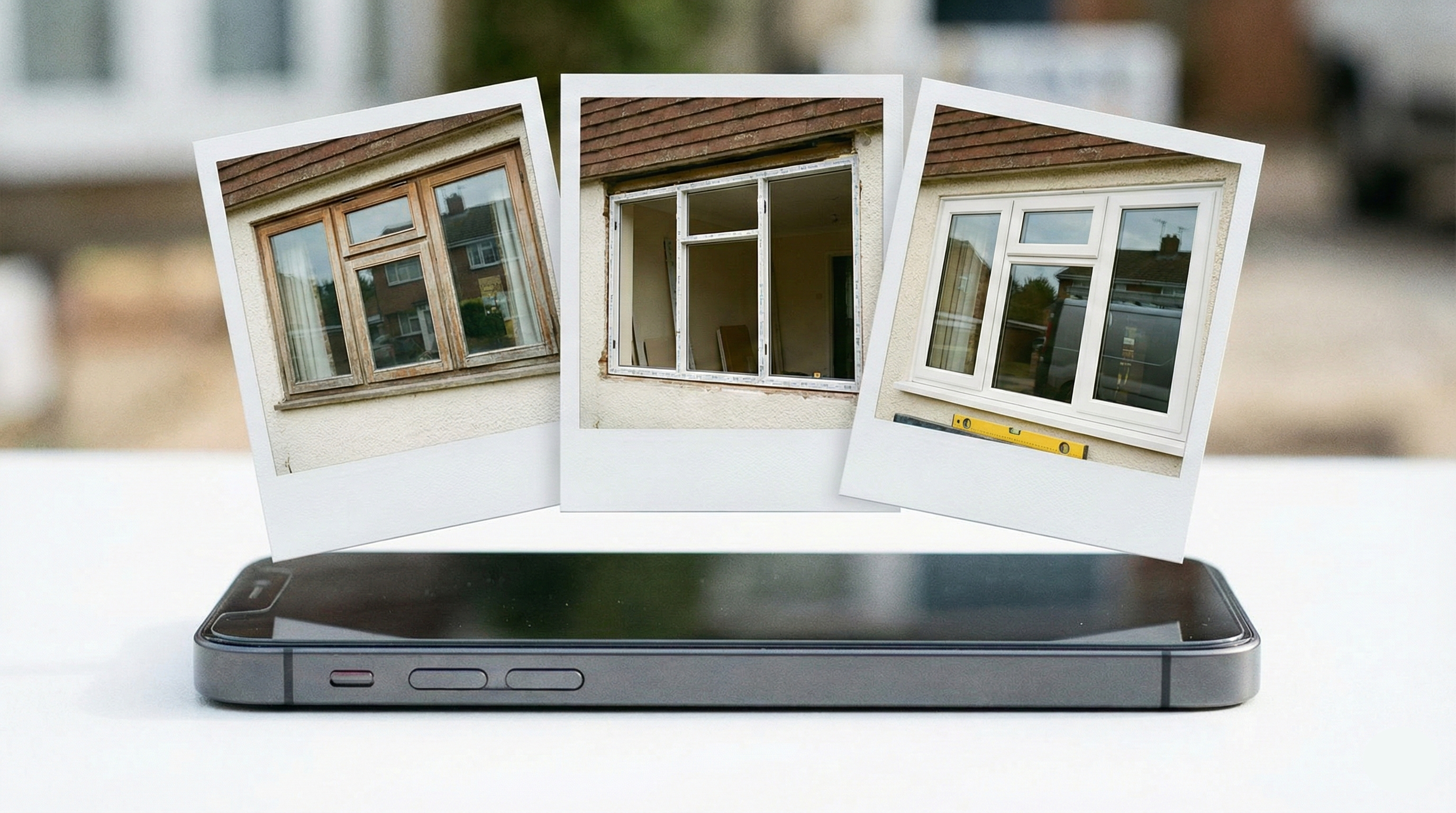
Every window fitter knows they should take photos. Most do, at least some of the time. But here's what separates the companies that win work from photos from those that don't: it's not about taking them. It's about being able to find them.
Right now, somewhere in your phone's camera roll, there are hundreds of job photos mixed in with screenshots, family pictures, and that thing you photographed so you'd remember to buy it later. Some of those photos could win you your next job. But you'd need twenty minutes to find them, and by then the moment's passed.
Organised job photos aren't just good practice. They're a sales tool, a legal shield, and a marketing asset - but only if you can actually use them.
The photo you'll wish you had
Six months after an install, a customer calls. There's a crack in the plaster around the window frame. They're certain your fitters caused it. They want it fixed, or they're leaving a bad review.
You're pretty sure that crack was there before you started. You remember your lad mentioning it. But can you prove it?
If you have a dated "before" photo showing that crack already existed, the conversation is over. You send the photo, the customer apologises, everyone moves on. If you don't have that photo, you're either eating the cost of a repair you didn't cause or fighting a losing battle against a bad review.
This scenario plays out constantly in fitting businesses. Damage to sills, marks on walls, pre-existing condensation problems, hardware that was already worn. The "before" photo is your evidence that the problem wasn't yours. Without it, it's your word against theirs - and the customer usually wins that argument.
"Can you show me some of your work?"
You're quoting a job. Nice house, decent-sized project. The customer asks if you've done anything similar nearby. You have - three doors down, in fact, about eight months ago. Beautiful anthracite grey bi-folds.
But can you show them?
If your photos are organised by job, you pull up the bi-fold project in seconds. Before shot of the old patio doors. Progress shot of the opening being widened. Finished shot of the bi-folds open onto the garden. The customer sees quality work, locally, on a similar property to theirs.
If your photos are in your camera roll, you're scrolling through eight months of images while the customer watches. You find one completion shot but it's at a weird angle. You mutter something about having more somewhere. The moment's lost. You look disorganised, and they're now wondering what else you're disorganised about.
The difference between these two scenarios is often the difference between winning and losing the job. Not because of skill or price, but because of presentation.
Your best marketing costs nothing to create
Every completed job is a piece of marketing you've already paid for. The labour's done, the materials are installed, the customer's happy. All you need to do is capture it properly.
A good completion photo - properly lit, frame filling the shot, showing the quality of the finish - can be used on your website, your Google Business profile, your Facebook page, in quotes to similar customers. One photo, dozens of uses, zero additional cost.
But here's what actually happens: your fitter finishes the job, snaps a quick photo while the customer's signing off, and moves on to the next job. That photo sits in their camera roll. Maybe they text it to the office. Maybe they don't. Either way, it never makes it to your website because nobody knows where it is or can be bothered to dig it out.
Six months later, your website still shows the same three projects from 2019, and you're losing online leads to competitors whose portfolios look fresher and more active.
What "organised" actually means
Let's be specific. Organised job photos means:
- Attached to the job, not the person. The photos live with the job record, not in someone's camera roll. Anyone on the team can find them. They don't disappear when someone changes phone or leaves the company.
- Categorised by stage. Before, during, after. Not just a pile of images with no context. When you need the "before" shot, you go to before. When you need completion photos for marketing, you go to after. No scrolling, no guessing.
- Captured as part of the workflow. Not something you remember to do when you remember to do it. The system prompts for photos at the right moments, so it becomes habit rather than afterthought.
- Accessible from anywhere. At the customer's house during a quote. In the office when someone calls with a query. On site when you need to check what something looked like before you started.
This isn't complicated. It's just discipline made easy by having the right system.
How FitterPal handles job photos
In FitterPal, every job has a photos section divided into before, during, and after. When a fitter's on site, they open the job, tap the camera, and the photo goes straight into the right category. No texting it to the office. No remembering to upload later. It's there, attached to the job, immediately.
Back in the office, or on your phone six months later, you can pull up any job and see its full photo history. The before shots from the survey. The progress shots during the install. The completion photos when everything was finished. All in one place, all findable in seconds.
When a customer calls with a complaint, you're not asking "who was on that job?" and "can you check your phone?". You're looking at the photos yourself, on the call, resolving it there and then.
When you're quoting a similar job, you can show the customer relevant completed work without fumbling through your camera roll. It's just there.
The fitter resistance myth
"My fitters won't bother taking photos properly." You might be thinking this. It's a common objection.
But here's what's actually true: fitters don't resist taking photos. They resist hassle. If taking a photo means unlocking their phone, opening the camera, taking the shot, then later remembering to text it to the office or upload it somewhere - that's hassle. Of course they don't do it consistently.
If taking a photo means tapping the job they're already looking at and hitting a camera button, that's not hassle. That's two taps. The photo's uploaded, categorised, and done. No extra steps, no remembering later.
The difference isn't motivation. It's friction. Remove the friction and the photos appear. Keep the friction and they don't.
Three situations where this pays for itself
The disputed damage call. Customer claims you cracked their plaster. You pull up the before photo showing the existing crack. Conversation over. Value: the £200 repair you didn't have to pay for, plus the bad review you didn't receive.
The "show me similar work" moment. Customer's on the fence. You show them three completed projects matching their spec. They see you've done this before, done it well, done it nearby. They sign. Value: the job you won because you looked professional.
The website refresh. End of the year, you decide to update your portfolio. Instead of asking every fitter to dig through their phones, you export completed job photos from the last twelve months. Done in an afternoon. Value: the leads you'll win from a website that actually shows recent work.
Any one of these scenarios covers the cost of having a proper system. All three happen regularly in any active fitting business.
The photos are the easy part
Your fitters are already taking photos. Some of the time, anyway. The photos exist. They're just scattered across devices, lost in chat threads, buried in camera rolls.
The hard part isn't capturing images. It's capturing them in a way that makes them useful later. Before, during, after. Attached to the job. Findable in seconds by anyone who needs them.
That's what turns photos from a vague good intention into a sales tool, a legal protection, and a marketing engine.
FitterPal makes the organisation automatic. You keep doing what you're already doing - taking photos on the job - but now they land somewhere useful instead of disappearing into the void.
Book a demo today where we can walk you through how our system helps you organise your photos.
Book a demo today where we can walk you through how our system helps you organise your photos.