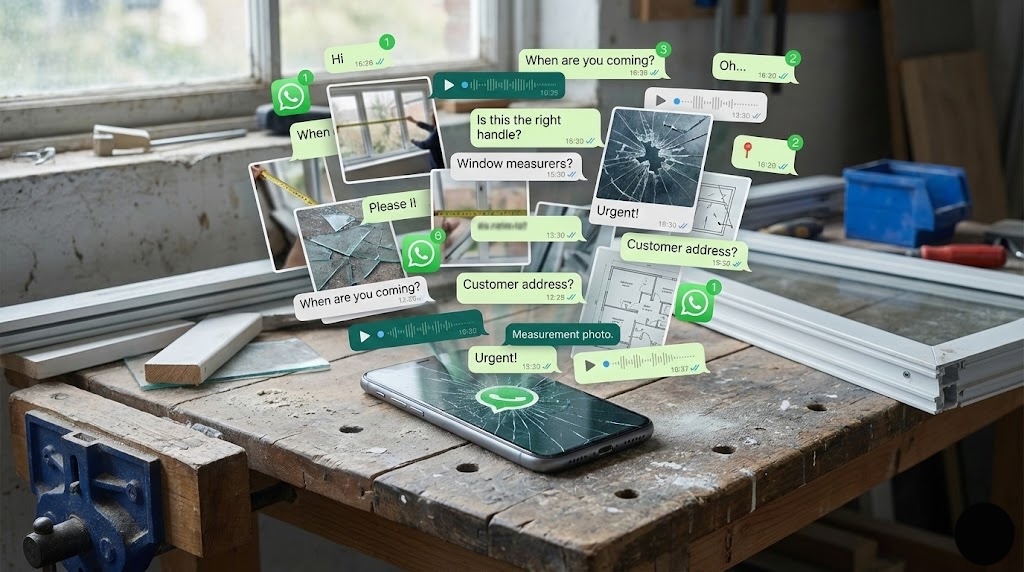
It starts innocently enough. A customer texts you on WhatsApp because it's easier than calling. You reply. They send photos of their existing windows. You ping back some availability. Before you know it, your entire business is running through those green bubbles.
And why not? It's free. Everyone's got it. Your fitters are already on their phones anyway. It feels like the obvious solution.
But WhatsApp isn't a business tool. It's a messaging app that your business has colonised. And that distinction is costing you more than you realise.
The photo graveyard in your camera roll
Quick test: find the photos from that job on Maple Avenue you did eight months ago. The ones the customer sent before you quoted, the ones your fitter took during the install, and the completion shots.
If you can do that in under two minutes, you're in the minority. For everyone else, those photos are scattered across three different WhatsApp threads, your camera roll (somewhere between holiday snaps and screenshots), and possibly a group chat that's now buried under 400 unread messages.
This isn't just an inconvenience. It's a liability.
When a customer calls six months later claiming you damaged their sill, you need those before photos. When someone asks to see examples of your bi-fold installations, you need those completion shots. When FENSA needs documentation, you need evidence that the job was done properly.
WhatsApp makes it easy to receive photos. It makes it nearly impossible to find them again.
"What did they say about the back door?"
You're on site. The customer mentions something about a cat flap they discussed with the office. Or was it a letterbox? They definitely spoke to someone. You scroll back through the chat, but it's 200 messages deep and half of them are voice notes you don't have time to listen to.
So you wing it. Or you call the office, interrupting whatever they're doing. Or you ask the customer to repeat themselves, which doesn't exactly scream "professional outfit."
This is the information fragmentation problem. WhatsApp conversations are linear and endless. There's no way to attach a message to a specific job. No way to separate what the customer said about the front windows from what they said about the conservatory quote. It's all just... chat.
Your fitters shouldn't need to be archaeologists, digging through message history to understand what they're supposed to be doing today.
The 9pm problem
WhatsApp doesn't have office hours. Neither do your customers, apparently.
When your business runs on WhatsApp, you're implicitly telling people they can reach you anytime. Sunday morning. Tuesday at 10pm. Bank holidays. Because if you don't reply, they might think you're ignoring them. And if you do reply, you've just trained them to expect instant responses.
This is the boundary erosion that nobody talks about. Your business phone becomes a conduit for work at all hours. The blue ticks create pressure to respond. The line between "running a business" and "being always on" disappears.
You didn't become a window fitter to answer messages at your kid's football match. But here we are.
When a fitter leaves, the knowledge walks out with them
Your longest-serving fitter has years of customer conversations on his phone. He knows that Mrs. Patterson on Church Lane is fussy about clean-up. He knows that the access at the Hendersons' place is tricky and you need to park two streets away. He knows that the developer on the new-build site pays late but always pays.
That knowledge lives in his WhatsApp threads. Not in your business.
When he leaves - and people do leave - that institutional memory walks out the door with him. The next person to visit Mrs. Patterson won't know to be extra careful. The next quote to the developer won't factor in the payment delays. You're starting from scratch with customers you've served for years.
A business that runs on WhatsApp is a business where critical information is held hostage by whoever happens to have been messaged.
The accountability black hole
"I told Dave about the special handle." "No you didn't." "Yes I did, check the chat."
Now someone's scrolling through WhatsApp trying to prove who said what to whom and when. Maybe it was in the group chat. Maybe it was a direct message. Maybe it was a voice note that nobody can be bothered to listen to again.
WhatsApp creates the illusion of communication while making accountability nearly impossible. Messages get lost in the scroll. Voice notes are unindexed and unsearchable. Things get said but not recorded in any usable way.
This isn't about blame. It's about having a clear record of what was agreed, who was responsible, and what actually happened. When everything's in WhatsApp, that clarity doesn't exist.
What "organised" actually looks like
The alternative isn't complicated. It's not about abandoning WhatsApp entirely or installing some enterprise software that needs a training course. It's about having one place where everything about a job lives together.
Photos attached to the job they belong to, not lost in a camera roll. Notes that anyone on the team can read, not buried in a private chat. A history of what's been done and what's outstanding, visible to everyone who needs it.
That's what FitterPal does. Each job becomes a container for everything related to it: the customer details, the survey notes, the photos from before, during, and after, the schedule, the updates from site. When someone needs information, it's there. When someone leaves, the knowledge stays.
You can still use WhatsApp to chat with your mates. But your business stops depending on it.
The transition isn't as painful as you think
Most fitters worry that moving away from WhatsApp means forcing their team to learn something new. That there'll be resistance. That the lads won't use it.
Here's what actually happens: once people can find information without scrolling through months of messages, they don't want to go back. Once photos are where they're supposed to be, the frustration disappears. Once there's a clear record of what's happening on each job, the arguments stop.
The resistance isn't to new tools. It's to friction. Make the right thing easier than the wrong thing, and people follow.
WhatsApp is free. But it's not cheap.
The hidden cost is the time you spend searching for photos. The jobs that go wrong because information didn't get passed on. The evenings spent answering messages because there's no boundary. The knowledge that evaporates when people leave.
None of this shows up on a bill. But it shows up in your margins, your stress levels, and the professionalism of your operation.
You can keep running your business through WhatsApp. Plenty of fitters do. But the ones who grow past a certain point all hit the same wall: the tools that got you here won't get you there.
FitterPal was built for that wall. For the moment when you realise you need a system, not just a chat.
Book a demo today where we can walk you through how our system helps you organise your jobs better.
Book a demo today where we can walk you through how our system helps you organise your jobs better.